


Year
2025
Scope
Web Design
Duration
12 weeks
One apartment. Multiple tenants.
TrueLease allows multiple tenants living in the same apartment to connect to a shared apartment profile. Each tenant has an individual account, while the apartment acts
as a shared space where residents and their landlord or property manager can stay up
to date on important information.
Tenant 1
Tenant 2
Tenant 3
Apartment
Shared apartment profile
Property manager
Maintenance
Documents
Updates
Payments
Announcement
TrueLease
This app gives tenants and property managers one clear place to handle rent, maintenance, and communication, so nothing gets lost, misunderstood, or chased manually.
Build trust through transparency
Ensure all actions, updates, and changes are visible, time-stamped, and traceable, so neither tenants nor owners are left guessing or disputing what happened.
Reduce anxiety through clarity
Make critical information like rent status, lease time left, and issue progress instantly understandable at a glance, without forcing users to dig or calculate.
Encourage accountability on both sides
Design clear ownership and status states for payments and maintenance, making responsibilities explicit and reducing follow-ups and blame.
Keep interactions calm and human
Use clear language, predictable layouts, and minimal cognitive load to prevent stress in already sensitive situations related to housing.
Context
Survey Insights
62% of respondents avoid using rental apps
due to unclear onboarding and a lack of structured tenant–landlord communication.
71% of users said conversations move outside the app because in-app communication
is unstructured, leading to lost records and reduced transparency.
58% of users reported low trust in existing
rental apps due to unclear processes, inconsistent updates, and poor visibility into actions.

User Interviews
4 out of 6 tenants interviewed described feeling anxious or powerless after raising issues, primarily due to the lack of progress tracking and accountability.
Both tenants and landlords found existing apps confusing, with user flows that do not reflect
real-world rental communication or expectations.
A recurring theme across interviews was the absence of trust in the system itself, which often
led users to abandon the app mid-process.

Ensure all actions, updates, and changes are visible, time-stamped, and traceable, so neither tenants nor owners are left guessing or disputing what happened.
Research Insights
analysis
Hear what our personas have to say

Student renter, lives away from family, and manages rent and issues independently.
Know exactly what’s due, when, and what’s already done.
Track maintenance requests without chasing people.
Feel in control of their living situation.
Goals
Unclear rent status or surprise charges.
No visibility into issue progress.
Communication that disappears into thin air.
Frustrations
Clear rent breakdowns and timelines.
Issue history with timestamps and updates.
Simple, respectful communication.
Needs
"I just want things to work and not feel stupid asking twice."
Jack

New to renting, unfamiliar with lease terms, processes, and rights.
Understand what's expected of them.
Avoid mistakes or penalties.
Feel confident navigating rental responsibilities.
Goals
Legal language and unclear rules.
Fear of doing something wrong.
Lack of guidance or context.
Frustrations
Plain-language explanations.
Clear timelines and reminders.
Transparent records they can refer back to.
Needs
"I don't know what I don't know."
Emily

Manages multiple units, not emotionally invested in any single tenant, values efficiency.
Reduce repetitive tenant queries.
Maintain records for rent and issues.
Close issues quickly with minimal back-and-forth.
Goals
Tenants following up because they lack visibility.
Information scattered across calls, WhatsApp, and email.
No clean audit trail if disputes arise.
Frustrations
Clear rent breakdowns and timelines.
Issue history with timestamps and updates.
Simple, respectful communication.
Needs
"If it's logged, I shouldn't have to explain it again"
Daniel
research
Workflow
Entry/ Authentication Workflow
Enter details
Create password
Choose Tenant or Agent
Click Send OTP
Enter code
Verify OTP
Enter property details
Upload lease documents
Enter invite code
Continue
Profile Setup Workflow
Go to Reports
Click New Report
Enter issue details
Submit report
Ticket created
Report issue workflow
Open Profile
Go to Property Details
Edit information
Save details
Edit property details workflow
DESIGN direction


I focused on figuring out how the system should work rather than how it should look. I used low-fidelity sketches to explore onboarding flows, handle missing information, and understand how different features depend on each other.
Sketching and Wireframes


Launch screen
Login screen
Enter your details and create account
Member authentication
Verify your identity
New user dashboard
Report your issue
Confirmation screen—Ticket created.
Member authentication
Verify your identity
Hi-fi Designs
High-fidelity designs helped me check whether my ideas actually worked when everything was visible at once. Things that felt clear in wireframes sometimes felt confusing, heavy, or too demanding once real copy, spacing, and actions were added. This phase helped catch those problems early.
BRINGING IT TOGETHER

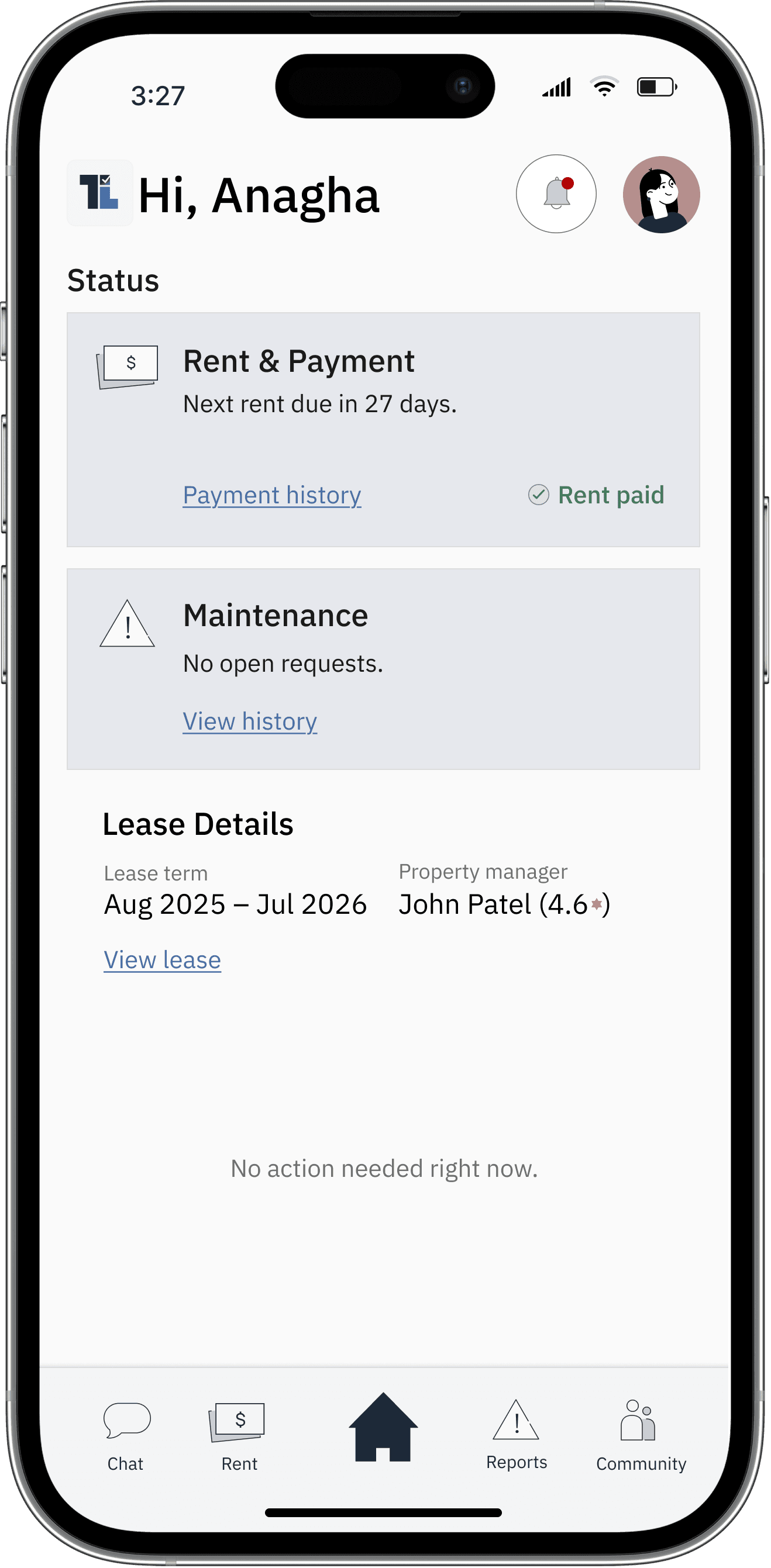
Rent due
1 active request
Rent cycle complete
Null active requests
"Pay rent" button activates
System states
Iterations & tradeoffs
Used empty space on purpose to create a calmer, quieter experience instead of filling the screen with noise.
03
Replaced detailed issue lists with a short status summary so users aren't constantly reminded of problems.
04
Simplified the dashboard to one clear focus instead of many cards, making it easier to understand and less stressful to look at.
01
Kept search, badges, and reputation off the dashboard to maintain a neutral, trustworthy feel instead of pushing engagement.
02
Turned rent actions into clear, easy-to-read states so users know exactly what's done and what's not.
05
TrueLease
A transparent tenant–owner communication system that reduces delays, improves accountability, and enables timely resolution of housing issues.
Year
2025
Scope
Web Design
Duration
12 weeks
One apartment. Multiple tenants.
TrueLease allows multiple tenants living in the same apartment to connect to a shared apartment profile. Each tenant has an individual account, while the apartment acts as a shared space where residents and their landlord or property manager can stay up to date on important information.
Property manager
Tenant 1
Tenant 2
Tenant 2
Updates
Announcement
Documents
Payments
Maintenance
Apartment
Shared apartment profile
TrueLease
This app gives tenants and property managers one clear place to handle rent, maintenance, and communication, so nothing gets lost, misunderstood, or chased manually.
Build trust through transparency
Ensure all actions, updates, and changes are visible, time-stamped, and traceable, so neither tenants nor owners are left guessing or disputing what happened.
Reduce anxiety through clarity
Make critical information like rent status, lease time left, and issue progress instantly understandable at a glance, without forcing users to dig or calculate.
Encourage accountability on both sides
Design clear ownership and status states for payments and maintenance, making responsibilities explicit and reducing follow-ups and blame.
Keep interactions calm and human
Use clear language, predictable layouts, and minimal cognitive load to prevent stress in already sensitive situations related to housing.
Survey Insights
62% of respondents avoid using rental apps due to unclear onboarding and a lack of structured tenant–landlord communication.
71% of users said conversations move outside the app because in-app communication is unstructured, leading to lost records and reduced transparency.
58% of users reported low trust in existing rental apps due to unclear processes, inconsistent updates, and poor visibility into actions.
User Interviews
4 out of 6 tenants interviewed described feeling anxious or powerless after raising issues, primarily due to the lack of progress tracking and accountability.
Both tenants and landlords found existing apps confusing, with user flows that do not reflect real-world rental communication or expectations.
A recurring theme across interviews was the absence of trust in the system itself, which often led users to abandon the app mid-process.
Ensure all actions, updates, and changes are visible, time-stamped, and traceable, so neither tenants nor owners are left guessing or disputing what happened.
Research Insights
Hear what our personas have to say
Student renter, lives away from family, and manages rent and issues independently.
Know exactly what’s due, when, and what’s already done.
Track maintenance requests without chasing people.
Feel in control of their living situation.
Goals
Unclear rent status or surprise charges.
No visibility into issue progress.
Communication that disappears into thin air.
Frustrations
Clear rent breakdowns and timelines.
Issue history with timestamps and updates.
Simple, respectful communication.
Needs
"I just want things to work and not feel stupid asking twice."
Jack
New to renting, unfamiliar with lease terms, processes, and rights.
Understand what's expected of them.
Avoid mistakes or penalties.
Feel confident navigating rental responsibilities.
Goals
Legal language and unclear rules.
Fear of doing something wrong.
Lack of guidance or context.
Frustrations
Plain-language explanations.
Clear timelines and reminders.
Transparent records they can refer back to.
Needs
"I don't know what I don't know."
Emily
Manages multiple units, not emotionally invested in any single tenant, values efficiency.
Reduce repetitive tenant queries.
Maintain records for rent and issues.
Close issues quickly with minimal back-and-forth.
Goals
Tenants following up because they lack visibility.
Information scattered across calls, WhatsApp, and email.
No clean audit trail if disputes arise.
Frustrations
Clear rent breakdowns and timelines.
Issue history with timestamps and updates.
Simple, respectful communication.
Needs
"If it's logged, I shouldn't have to explain it again"
Daniel
Workflow
Entry/ Authentication Workflow
Enter details
Create password
Choose Tenant or Agent
Click Send OTP
Enter code
Verify OTP
Enter property details
Upload lease documents
Enter invite code
Continue
Profile Setup Workflow
Go to Reports
Click New Report
Enter issue details
Submit report
Ticket created
Report issue workflow
Open Profile
Go to Property Details
Edit information
Save details
Edit property details workflow
Sketching and Wireframes
I focused on figuring out how the system should work rather than how it should look. I used low-fidelity sketches to explore onboarding flows, handle missing information, and understand how different features depend on each other.
Hi-fi Designs
High-fidelity designs helped me check whether my ideas actually worked when everything was visible at once. Things that felt clear in wireframes sometimes felt confusing, heavy, or too demanding once real copy, spacing, and actions were added. This phase helped catch those problems early.
System states
Iterations & tradeoffs
Used empty space on purpose to create a calmer, quieter experience instead of filling the screen with noise.
Replaced detailed issue lists with a short status summary so users aren't constantly reminded of problems.
Simplified the dashboard to one clear focus instead of many cards, making it easier to understand and less stressful to look at.
Kept search, badges, and reputation off the dashboard to maintain a neutral, trustworthy feel instead of pushing engagement.
Turned rent actions into clear, easy-to-read states so users know exactly what's done and what's not.
Similar Templates
Year
2025
Scope
Web Design
Duration
12 weeks
TrueLease
This app gives tenants and property managers one clear place to handle rent, maintenance, and communication, so nothing gets lost, misunderstood, or chased manually.
Context
Build trust through transparency
Ensure all actions, updates, and changes are visible, time-stamped, and traceable, so neither tenants nor owners are left guessing or disputing what happened.
Reduce anxiety through clarity
Make critical information like rent status, lease time left, and issue progress instantly understandable at a glance, without forcing users to dig or calculate.
Encourage accountability on both sides
Design clear ownership and status states for payments and maintenance, making responsibilities explicit and reducing follow-ups and blame.
Keep interactions calm and human
Use clear language, predictable layouts, and minimal cognitive load to prevent stress in already sensitive situations related to housing.
One apartment. Multiple tenants.
TrueLease allows multiple tenants living in the same apartment to connect to a shared apartment profile. Each tenant has an individual account, while the apartment acts as a shared space where residents and their landlord or property manager can stay up to date on important information.
Tenant 1
Tenant 2
Tenant 3
Apartment
Shared apartment profile
Property manager
Maintenance
Documents
Updates
Payments
Announcement
Announcement
Survey Insights
62% of respondents avoid using rental apps due to unclear onboarding and a lack of structured tenant–landlord communication.
71% of users said conversations move outside the app because in-app communication is unstructured, leading to lost records and reduced transparency.
58% of users reported low trust in existing rental apps due to unclear processes, inconsistent updates, and poor visibility into actions.
User Interviews
4 out of 6 tenants interviewed described feeling anxious or powerless after raising issues, primarily due to the lack of progress tracking and accountability.
Both tenants and landlords found existing apps confusing, with user flows that do not reflect real-world rental communication or expectations.
A recurring theme across interviews was the absence of trust in the system itself, which often led users to abandon the app mid-process.
Ensure all actions, updates, and changes are visible, time-stamped, and traceable, so neither tenants nor owners are left guessing or disputing what happened.
Research Insights
Hear what our personas have to say
Student renter, lives away from family, and manages rent and issues independently.
Know exactly what’s due, when,
and what’s already done.Track maintenance requests without chasing people.
Feel in control of their living situation.
Goals
Unclear rent status or surprise charges.
No visibility into issue progress.
Communication that disappears into thin air.
Frustrations
Clear rent breakdowns and timelines.
Issue history with timestamps
and updates.Simple, respectful communication.
Needs
"I just want things to work and not feel stupid asking twice."
Jack
New to renting, unfamiliar with lease terms, processes, and rights.
Understand what's expected of them.
Avoid mistakes or penalties.
Feel confident navigating rental
responsibilities.
Goals
Legal language and unclear rules.
Fear of doing something wrong.
Lack of guidance or context.
Frustrations
Plain-language explanations.
Clear timelines and reminders.
Transparent records they can refer back to.
Needs
"I don't know what I don't know."
Emily
Manages multiple units, not emotionally invested in any single tenant, values efficiency.
Reduce repetitive tenant queries.
Maintain records for rent and issues.
Close issues quickly with minimal back-and-forth.
Goals
Tenants following up because they lack visibility.
Information scattered across calls, WhatsApp, and email.
No clean audit trail if disputes arise.
Frustrations
Clear rent breakdowns and timelines.
Issue history with timestamps and updates.
Simple, respectful communi-cation.
Needs
"If it's logged, I shouldn't have to explain it again"
Daniel
Workflow
Entry/ Authentication Workflow
Enter property details
Upload lease documents
Enter invite code
Continue
Profile Setup Workflow
Go to Reports
Click New Report
Enter issue details
Submit report
Ticket created
Report issue workflow
Open Profile
Go to Property Details
Edit information
Save details
Edit property details workflow
Enter details
Create password
Choose Tenant or Agent
Click Send OTP
Enter code
Verify OTP
Sketching and Wireframes
I focused on figuring out how the system should work rather than how it should look. I used low-fidelity sketches to explore onboarding flows, handle missing information, and understand how different features depend on each other.
Launch screen
Login screen
Enter your details and create account
Member authentication
Verify your identity
New user dashboard
Report your issue
Confirmation screen—Ticket created.
Member authentication
Verify your identity
Hi-fi Designs
High-fidelity designs helped me check whether my ideas actually worked when everything was visible at once. Things that felt clear in wireframes sometimes felt confusing, heavy, or too demanding once real copy, spacing, and actions were added. This phase helped catch those problems early.
System states
Iterations & tradeoffs
Used empty space on purpose to create a calmer, quieter experience instead of filling the screen with noise.
Replaced detailed issue lists with a short status summary so users aren't constantly reminded of problems.
Simplified the dashboard to one clear focus instead of many cards, making it easier to understand and less stressful to look at.
Kept search, badges, and reputation off the dashboard to maintain a neutral, trustworthy feel instead of pushing engagement.
Turned rent actions into clear, easy-to-read states so users know exactly what's done and what's not.
Similar Templates
Similar Templates